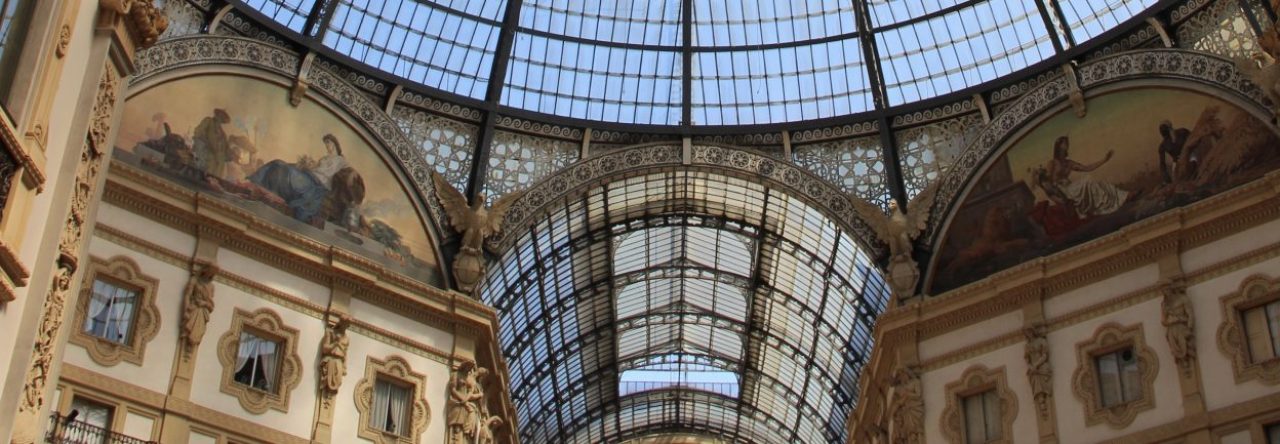
Coffee is really good her, Italy is the home of espresso and cappucino, but the prices are a mere fraction of what you see at e.g. Starbuck’s. You can get your coffe exactly as you like it, baristas here are used to special requests.
We have lots of suggestions for where to drink your coffee in the different areas in Milan here.
Different prices
Most other places a cup of coffee costs the same whether you enjoy it standing up at the bar, sitting down inside or taking it outside at the tables in front of the café. It doesn’t work that way in the south of Europe.
The cheapest version of coffee is enjoyed at the bar standing up, but it can become quite costly if you would like to sit down and want it served at a table.
What to order
There are countless variations of coffee; an espresso can be lungo (long), ristretto (concentrated), macchiato (stained- with a drop of milk) macchiato caldo o freddo (with warm or cold milk), cappuccino with eiter cow milk, soy milk , oat milk, almond milk or rice milk. or would you like a cortado? Just ask for a marrocchino. Furhtermore there is the caffè corretto which is an espresso with a shot of grappa or liqueur in it.
You can also get a Latte macchiato, which is the closest you can get to a latte
During summer it is nice and refreshing to get an ice coffee or “caffè shakerato” (shaked coffee) instead of the traditional espresso. Prices depend on where you drink it and whether you stand or sit outdoors .
There is also Affogato (drowned) coffee, a coffe based dessert with a scoop of vanilla or tartufo ice cream “drowned” by a shot of espresso coffee.
Hot chocolate like you’ve never seen it before
Then there is Cioccolata calda con panna – hot chocolate with whipped cream, which is a very different drink from the one you are used to, in Italy it is a very dense drink, more like a hot chocolate mousse, it’s delicious but be prepared for the difference.
Oh, and by the way Barista is just Italian for bartender 🙂
We do like a great brunch at the weekend. We have selected some of the best Milan has to offer divided by area. Prices are € – €15-20, €€ – 20-40, €€€ – 40-60. One of the peculiarities of brunch places in Milan is a rotation system so you won’t be able to hang out for the entire duration, it is necessary to book if you want to be sure to get a table (we have included their phone numbers).
Radetzky €€ 105, Corso Garibaldi (find on map) +39026572645 8-1.30 am Monday to Thursday, 8-2 am Friday and Saturday and 10-1.30 am Sunday – great location and service.
Cascina Nascosta (The hidden fartmhouse) €€ 14, Viale Emilio Alemagna (find on map) in the middle of Parco Sempione and yet tucked away and unknown to many +393406755196
LùBar €€ (brunch a la carte) 16, Via Palestro (find on map) +390283527769 – book at l’east 2 days in advance for the weekend. It more a lunch place but you can light dishes + cappuccino, coffee and orange juice. 8 am-midnight Tuesdays-Sundays
When you’ve been traveling a lot you begin to look for experiences that get you closer to the local population, because who wants to sit at the hotel and have dinner when you could be out meeting people and getting some fun anecdotes to tell.
It may take some courage, but isn’t it the courageous decisions you never regret? So if you feel like a slightly different evening in the company of Italians, try a cooking course in Italian. Nothing beats “I learned how to make this sauce from a chef in Milan” when your friends come over.
Shopping at the market and cooking at a private home
You can choose the very personal experience with a course in English at a private home,Elena opens the doors to her home in the center of Milan and on market days she takes you to the local open air food market to pick the fresh seasonal products for your cooking class.
Aurora holds both morning and evening classes with a professional chef and she lves by the yellow metro line 4 stops from Duomo. If you can’t make it to her courses (or for some reason don’t feel like participating) you can still come and have dinner with the paticipants.
Both Clara and Aurora put emphasis on the fact that their courses aren’t just about cooking but also about socializing.
You can also try Casa Pastrocchi where Niccolò and Francesca give you a unique introduction to Italian food and wine. They offer an 3 1/2 hour cooking experience that starts with a classical aperitivo and includes wine tasting – they are certified sommeliers – check out on their website (English) here.
Cooking school at Teatro7
Another possibilty is the cooking school Teatro7(Find on map) where they teach in Italian but you can be certain that they will try anything with a combination of gestures and English to make you understand. And if Italians have bad English skills their gesturing is formidable.
You are guaranteed to have an entertaining evening and you will learn to make some great food. At Teatro7 you get the course including dinner from €75 to €150. Check out our Right now in Milan (in the menu) for courses.
Important instructions for booking a course online as the course calendar only exists in Italian: first click on the red Guarda il Menu button next to your course, on the next page click on “prenota il corso” at the top of the page (book) and then the rest of the instructions are in English, if you don’t receive a confirmation via email within 24 hours, send an email to iscrizioni@teatro7.com – you won’t be able to attend if you don’t have the email. The course calendar is here.
ATMosfera – Milan is proud of its old trams that follow different routes. A special attraction is the ATMosfera trams from 1928, which have been turned into moving restaurants, where you can experience the city while having lunch or dinner.
A fantastic place for tasting wine in Milan is the historical winebar and -shop Cantine Isola located in Milan’s Chinatown at 30, Via Paolo Sarpi (find on map)
Franciacorta spumante, classical method
As the first Lombard DOCG wine we have chosen the very sophisticated white (or maybe even rosé) sparkling wine, a DOCG spumante. classical method – also known as the Champenoise Method that is produced in Franciacorta(Lombardy, province of Brescia).
There are numerous quality wine producers, just to mention some of the most important. Visit the offical Franciacorta website ones: Barone Pizzini, Bellavista, Berlucchi, Ca’ del Bosco, Contadi Castaldi, Il Mosnel, Monte Rossa.
“Sparkling wine is a versatile wine that can be drunk with most typical Lombard dishes e.g. risotto with saffron and ossobuco, cold cuts and, obviously, seafood but it is actually also outstanding with pizza.” says sommelier Luisa Benetti.
Some suggestions for those of you, who want to buy wine to take home.
Franciacorta Official Sparkling Wine Sponsor at EXPO
Sforzato di Valtellina
Our next wine is a red wine and if you like a robust and intensely scented red wine with a deep red glow you need to try out the Sforzato di Valtellina (or Sfursàt as it’s called in the local dialect in the province of Sondrio). This wine comes from the mountains where the so-called heroic viticulture has produced a very interesting DOCG, A wine produced of Nebbiolo grapes, that have first been let to wither , which may sound a little negative, but which results in a very robust wine, locally it is called Chiavennasca.
“Lo Sfursàt is a robust and elegant win, which is aged in wooden barrels. It goes well with strong tasting meat dishes or aged cheese. But you can just as easily enjoy a glass after dinner” says Luisa..
Some of the best known producers are: Assoviuno, Bettini, Caven, Fay, Mamete Prevostini, Nera, Nino Negri, Plozza, Rainoldi, Triacca.
Some suggestions for those of you, who want to buy wine to take home.
€€€ (€40-50)
Nino Negri Sforzato di Valtellina – Sfursat 5 stelle 2011
Bettini – Sfursat di Valtellina 2011
€€ (€25-40)
Fay – Sforzato di Valtellina, Ronco del Picchio 2010
Assoviuno – Sforzato di Valtellina, San Bello 2008
Rainoldi – Sfursat di Valtellina 2010
Triacca – Sforzato di Valtellina, San Domenico 2010
Oltrpò Pavese, classical method
Our third DOCG wine comes from the area south of Milan in the hills in the province of Pavia and is another sparkling wine this time . Oltrepò Pavese Metodo Classico DOCG (Champenoise Method).
The main vine variety used is pinot nero which was brought here from France in the second half of the 19th century.
Our expert sommelier Luisa Benetti says:”This bubbly wine is suitable for vegetarian and vegan dishes e.g. risotto with strawberries or a more traditional pasta e fagioli (pasta with beans). But it’s perfect for an aperitivo with appetizers as well.”
Some producers: Anteo, Cà di Frara, Castello di Cigognola, Conte Vistarino, Giorgi, Montagna , Picchi, Podere San Giorgio, Tenuta il Bosco, Torrevilla, Travaglino, Vigne Olcru
Some suggestions for those of you who want to buy some of this wonderful wine
€€ (€30)
Oltrepò Pavese Metodo Classico Brut Rosé Victoria 2008 (pinot nero) – Vigne Olcru
€ (€18-21)
Oltrepò Pavese Metodo Classico Pinot nero Pas Dosé ‘more rosé 2011 (pinot nero) – Castello di Cigognola
Oltrepò Pavese Metodo Classico Cruasé (pinot nero) – Anteo
Oltrepò Pavese Metodo Classico Pinot nero Conte Vistarino 1865 – 2008 (pinot nero e chardonnay) – Conte Vistarino
For the fourth DOCG wine we return to the mountains in the province of Sondrio where we find a close relative to the Sforzato, an important red wine, the Valtellina Superiore DOCG.
It comes from the same vine variety the Nebbiolo, locally called Chiavennasca, from the same valley and the same heroic viticulture as the Sforzato and the Valtellina Superiore is also aged in barrels But an important difference is that the grapes aren’t left to wither.
If the label says ‘Riserva’ it means that it has been aged for at least three years..
Luisa Benetti, our sommelier and wine expert recommends the following five Cru: Grumello – Inferno – Sassella – Valgella – Maroggia.
“The Valtellina Superiore is intense and smooth and goes well with pizzoccheri alla Valtellinese or a dish of meat and porcino mushrooms.” Luisa says.
Some of the most important producers are: AR.PE.PE, Bettini, Caven, Fay, Mamete Prevostini, Nera, Nino Negri, Plozza, Rainoldi, Triacca
Here are some suggestions if you want to take some Valtellina Superiore home:
€€ (€22-35)
Valtellina Superiore La Botte Ventitre’ 2002 – Bettini
Valtellina Superiore Sassella San Lorenzo 2011 – Mamete Prevostini
Valtellina Superiore Riserva Signorie 2007 – Nera
Valtellina Superiore Inferno Carlo Negri 2011 – Nino Negri
Moscato di Scanzo
Like any self-respecting chef would we finish off with the dessert wine, the smallest DOCG in Italy, a real gem; the Moscato di Scanzo, a sweet red passito wine.
Scanzo is a small municipality in the province of Bergamo, its Moscato is a native Italian vine with an ancient history, the grapes are sun-dried for several weeks and the wine is aged for at least two years.
“The result,” says our wine expert, sommelier Luisa Benetti,”is a sweet wine that you can drink either with a chocolate tart or Marrons glacés – in Milan the most famous ones are from the Pasticceria Galli (find on map)”
Here are some ideas in case you want to buy some to take home:
€€€ (€35-50)
Locatelli Caffi – Moscato di Scanzo 2011
De Toma – Moscato di Scanzo 2011
Il Cipresso – Moscato di Scanzo Serafino 2010
La Brugherata – Moscato di Scanzo Doge 2011
Biava – moscato di Scanzo 2011
The best known producers are Biava – Cascina del Francès – Cerri – De Toma – Il Cipresso – La Brugherata -Locatelli Caffi
Orange wine is apparently all the rage so what is it and which Italian labels produce them?
They are the new rosé but rosé wine gets its colour from the skins of black grapes left to macerate for some time and then removed, so the wine doesn’t become red, whereas orange wines are made from white grapes and the macerating of the skins give them their spectacular colour, it is not a new process but a very old tradition indigenous to the Friuli Venezia Giulia region. They are perfect with raw fish, meat and venison. Read more here.
Here is list of the producers in Italy:
Abbazia San Giorgio Costadilà Draga-Miklus Dario Prinčič Gravner Il Carpino La Castellada Paraschos Porta del Vento Ronco Severo Sassotondo
Every region and city in Italy has its own specialities and culinary traditions. In the north of Italy people generally use more butter and rice compared to the south of the country. We also have a post about the local wine here.
Who doesn’t love risotto? Italy is Europe largest producer of rice and it is grown mainly in the flat and marshy Po valley aka the rice bowl of Italy and the Milanese love rice as much as they love pasta, the Risotto alla Milanese is a delicious creamy dish with saffron, which gives it its characteristic yellow colour, it can be eaten on its own but is often accompanied by marrow bone or as it is called in Italian Osso Buco – literally bone with a hole.
Minestrone alla milanese
Minestrone – or vegetable soup – in itself is not a typical Italian dish, it is served all over the country but the Milanes twist is that is prepared with rice in stead of pasta
Cassoeula
This is a pork and cabbage stew that is mainly eaten during the cold months of the year and can be hard to find at other times – you also probably would not want to eat it during summer heat. It is often served with polenta – see the next item on the list
Polenta
Polenta is a kind of cornmeal porridge and it can be served with a variety of things; cassoeula (se above), cheese – e.g. gorgonzola, which is a Milanese cheese, and cream. Polenta is so typically Northern Italian that people form the south often use the derogatory term “Polentone” when speaking of their northern compatriots.
Trippa alla milanese – Busecca
Busecca is tripe, or cow’s stomach, in Milanese dialect and it has long been a staple in the socalled peasant cuisine, it is prepared with beans, vegetables and broth and is a well-loved dish here in the north.
Cotoletta alla milanese
The cotoletta alla milanese is a breaded veal cutlet fried in butter, if it is very big it is featured on the menu as orecchio d’elefante – elephant ear – there are many local arguments over whether it should be boneless or have a bone, be very flat – more akin to a schnitzel – or higher and juicy,.
Mondeghili
Milanese meatballs that are made with leftover meat from e.g. making broth, usually beef mixed with liver mortadelle, grated cheese and bread, sausage and eggs just like other polpette, the big difference is that the meat for Mondeghili is pre-cooked.
Michetta
The michetta is the typical white bread roll from Northern Italy, the rolls are puffed and therefore nearly hollow and often used for panini – sandwiches – Michetta rolls must be eaten fresh and only last for one day.
Panettone
The panettone is the popular traditional Milanese Christmas cake, it is a tall, round and naturally leavened cake with candied citrus and raisins, it is a welcome gift when you are invited to people’s homes and supermarkets and pastry shops are brimming over with them from November to December.
Milan is an amazing city for night life and there are lots of clubs and Piazzas where you meet the young, the rich and the beautiful – and perhaps the famous.
There are many clubs in Milan and it is a good idea to check out the different Instagram profiles – where they have one – to book tickets and make sure you get in.
In the area near Corso Como there are three clubs:
Zinc , 36, Via Cesare Balbo (find på kort) a must-see place with great cocktails on a high level inear Bocconi University.
Porta Vittoria
Ai Chiostri Milano, 48, Via San Barnaba (find on map), this beautiful place is housed in a former convent, located just behind Milan’s court house, from the 1400s offers everything from breakfast, lunch, aperitivo and after dinner drinks.
In most countries we go directly to the restaurant and have a drink while we study the menu. In Milan you start with an aperitivo.
The aperitivo is an appetizer: a glass of wine or a cocktail with snacks, that you have before going out for dinner – at around 6-8 p.m..
Over the last couple of years the Milanese aperitivo, or as they call it happy hour, has evolved from being a quick cocktail into becoming an event that sometimes stretches over the entire night and the snacks have become a buffet, that doesn’t wake your appetite but stills your hunger.’
Duomo area
This is a great place to have an aperitivo on a terrace so your view of the Cathedral serves as a backdrop to your night.
Camparino, one of Milan’s oldest and most popular coctail bars Mosco, an absolute must for their world renowned Negroni, located at the start of Galleria Vittorio Emanuele at 21, Piazza del Duomo (find on map)
God save the food, 1, Piazza del Carmine (find on map) high quality buffet and cocktails right in the center of Milan in Brera.
Terrazza di Maison Moschino, Hotel Moschino,(find on map) it is a little pricier than most places (10-15€). It’s on 12, Viale Monte Grappa , super chic and very fashion.
Radetzky €€ 105, Corso Garibaldi (find on map) 8-1.30 am Monday to Thursday, 8-2 am Friday and Saturday and 10-1.30 am Sunday, not the cheapest place in Milan but great location and service.
On your way back from a shopping tour Tramè is a great place to have an aperitivo, in the middle of Brera and very lively (find on map) you may already know the place from a lunch! You won’t get any snacks here, just an excellent drink but you can try some of their delicious sandwiches with it, but you have to buy those on the side..
Isola area
Another good area to have an aperitivo together with the Milanese in is the very cosy Isola area (find on map). The best street is Via P. Borsieri (find on map) where the legendary jazz place Blue Note is too.
Here you also find super cool and beautiful Café Gorille, 20, Via Gaetano de Castillia (find on map) which is rich on atmosphere.
Arco della Pace and Parco Sempione area
This is definitely one of the hottest aperitivo places as well as being a place where the nightlife is particularly vibrant and fun.
Deseso at 2, Corso Sempione (find on map) offers all the classical cocktails but also some with a modern twist, service is excellent.
Living at 2, Piazza Sempione (find on map) is elegant and a bit of an institution in the Milanese aperitivo repertoire.
BhangraBar, 1, Corso Sepione (find on map) a more exotic place that appeals to a younger crowd.
Cascina Nascosta (The hidden fartmhouse) is located in the middle of Parco Sempione at 14, Viale Emilio Alemagna (find on map) tucked away and unknown to many, a real gem.
Navigli area
The Navigli area is also rich on aperitivo places such as Manhattan Navigli at 13, Ripa di Porta Ticinese (find on map).
Via Tortona /Via Savona (find on map) is an area with many cool brunch/lunch places and small boutiques and in the evening it’s a great place to have an aperitivo.
Gogol & Company 101, Via Savona (find on map) is a charming bookstore/art gallery/café/bar with a great aperitivo in unusual surroundings.Opening hours Tuesday-Sunday 9 a.m.-10 p.m.
Outside the beaten track but relatively close to MUDEC and Corso Vercelli:
Porta Venezia Area
MINT Garden café, 12, Via Felice Casati (find on map) a very cool place to have your aperitivo near Corso Buenos Aires.
Pandenus,15, Via Alessandro Tadino (find on mapt) has great cocktails, a fantastic buffet and a super cozy atmosphere.
Nottingham Forest, 1, Viale Piave (find on map) it has made it to the prestigious list of 50 Great Bars of the World published by the English Class Magazine. Very international crowd and their cocktails are pure molecular science.
Bar Basso, 39, Via Plinio (find on map) One of Milan’s historical cocktailbars, Inventors of the drink Negroni Sbagliato. Close to shopping area Corso Buenos Aires.
Porta Vittoria area
Ai Chiostri Milano, 48, Via San Barnaba (find on map), this beautiful place is housed in a former convent, located just behind Milan’s court house, from the 1400s offers everything from breakfast, lunch, aperitivo and after dinner drinks. Please note that they close at 4 pm on Saturdays and are closed on Sundays.
Deep Milano, 5, Via Galvano Fiamma (find on map) – an extensive choice of cocktails but classic and new.
If you want a gourmet experience, then try out these amazing places at reasonable prices. We have also selected the best vegan and vegetarian restaurants in Milan – look for VEGAN in the list.
Besides the names you can find in the Michelin guide we recommend the following places. The price levels are varied – € 20-30, €€ 30-50, €€€ >50 – but note that it isn’t necessary to spend a fortune to eat well
Our most important tip concerning good restaurants: Always book a table!
Carminio, 3, Via del Carmine (find on map) Phone +390272022992. Known for the menu which changes from day to day depending on the best fresh ingredients of the moment. €€/€€€
Temakinho which boasts three of the hottest restaurants in Milan right now. One is in 53, Corso Garibaldi (find on map). Phone +390272016158 €/€€
El Tombon de San Marc, a wonderful restaurant with traditional Lombard cuisine, you need to book a tbale here for both lunch and dinner 20, Via San Marco (find on map), Phone +39026599507. €/€€
EXIT Milano, 2, Piazza Erculea (find on map) Phone :+390235999080 elegant, delicious gourmet food and lovely place, food is served all day until midnight €€/€€€
Piz, 34, Via Torino (find on map) Phone +390286453482. Milan’s best Neapolitan Pizza, the menu only features 3 kinds of pizzas but they are absolutely worth the wait. Be prepared for a line but it moves quickly €
Il Brutto Anatrocolo, 3, Via Evangelista Torricelli (find on map), great food, excellent prices – you cannot book a table on Friday and Saturday nights, so you have to be there at leat 45 minutes in advance and queue-.€
There is an excellent restarant near this area, it requires you to take the metro from the DeAngeli station and get off at Primaticcio and then walk about 5 minutes but it really is one of Milan’s gastronomical gems and has 2 Michelin stars called IL Luogo di Aimo e Nadia at 6, Via Privata Raimondo Cuccoli (find on map) Phone +3902416886. €€€
Il Caffè della Pusterla, 22, Via Edmondo de Amicis (find on map) Phone+390283633659. A typical Milanese place, where you can get anything from breakfast to dinner. Fantastic atmosphere. €/€€